
Google has introduced the Agent Payments Protocol (AP2), an open standard designed with leading payments and technology firms to securely enable agent-led transactions across multiple platforms.
Agent Payments Protocol (AP2)
AP2 functions as an extension of Google’s Agent2Agent (A2A) and Model Context Protocol (MCP) frameworks, establishing a payment-agnostic structure that allows users, merchants, and payment providers to transact confidently across diverse payment types.
Need for AP2
AI agents increasingly conduct transactions on behalf of users, creating a requirement for a standardized system to authenticate, validate, and authorize agent payments. Traditional payment systems assume a human directly authorizes purchases. AP2 addresses this shift by ensuring:
- Authorization: Confirming a user has given explicit permission for a specific purchase.
- Authenticity: Ensuring merchant confidence that an agent’s request matches the user’s intent.
- Accountability: Establishing responsibility in case of fraudulent or incorrect transactions.
Stavan Parikh, VP/GM, Payments at Google, stated that AP2 helps maintain trust in scenarios where autonomous agents initiate payments, supporting consistent, secure, and auditable interactions across all payment methods, including credit/debit cards, real-time bank transfers, and stablecoins.
How AP2 Works: Mandates and Verifiable Credentials
AP2 relies on Mandates, cryptographically-signed, tamper-proof digital contracts, verified by verifiable credentials (VCs), to provide a chain of trust for agent transactions. Rao Surapaneni, VP/GM, Business Applications Platform, Google Cloud, explained that these mandates establish the foundation for every transaction.
- Real-time purchases (human present): A user requests an agent to find items, captured in an Intent Mandate. Once the agent presents a cart, a Cart Mandate is signed, confirming exact items and prices, creating an unalterable record.
- Delegated tasks (human absent): Tasks such as pre-authorized purchases (e.g., “Buy concert tickets when available”) are governed by detailed Intent Mandates that define conditions including timing, price limits, and other rules. Agents generate a Cart Mandate automatically when conditions are met.
This workflow produces a non-repudiable audit trail, linking the user’s intent, cart contents, and payment method while ensuring authorization, authenticity, and accountability.
Enabling New Commerce Scenarios
AP2’s flexible design supports both standard and innovative commerce models:
- Smarter shopping: Agents can monitor inventory and pricing, executing secure purchases automatically when specific conditions are met.
- Personalized offers: Merchant agents can respond to user intent with time-sensitive, customized offers, increasing sale value.
- Coordinated tasks: Agents can simultaneously book multiple services—flights, hotels, or event tickets—within user-defined constraints.
Support for Emerging Payment Systems
AP2 provides a universal, secure protocol for a variety of payments, including cryptocurrencies and stablecoins. In partnership with Coinbase, Ethereum Foundation, MetaMask, and others, Google has launched the A2A x402 extension, enabling production-ready agent-based crypto payments and extending AP2’s core functionality for web3 ecosystems.
Industry Collaboration and Future Prospects
Google is collaborating with over 60 organizations, including Adyen, American Express, Mastercard, PayPal, Revolut, Salesforce, and ServiceNow, to develop the AP2 ecosystem.
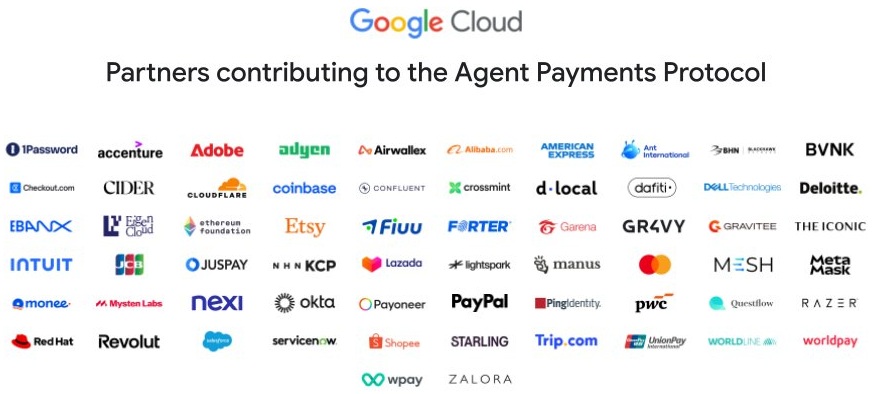
Partners building A2A agents are extending support to AP2, enabling new transactable experiences through the AI Agent Marketplace. Potential applications include B2B use cases such as autonomous procurement or automated scaling of software licenses via Google Cloud Marketplace.
Google encourages industry participation in open, collaborative development, including engagement with standards bodies, to further expand AP2’s capabilities.
Availability
Developers and organizations can access AP2 via Google’s public GitHub repository, which provides the complete technical specification, documentation, and reference implementations.
The repository will continue to be updated with contributions from Google and the community, demonstrating AP2’s scalability and application potential.