Meta has introduced Muse Voice Transcribe, a real-time audio perception model developed by Meta Superintelligence Labs. It is an autoregressive multimodal model from the Muse Spark family.
Real-time streaming ASR
Muse Voice Transcribe processes audio in 80ms chunks (12.5 Hz), with each chunk converted into a single soft token.
For each audio chunk, the model decides whether to continue listening or emit a text token:
- If it continues listening, it predicts
<|next_audio|>. - The
<|next_audio|>token is replaced with the actual audio chunk for the next input. - When the audio stream stops, an
<|empty_audio|>token tells the model there are no more audio chunks. - The model then emits the remaining text tokens without producing additional
<|next_audio|>tokens.
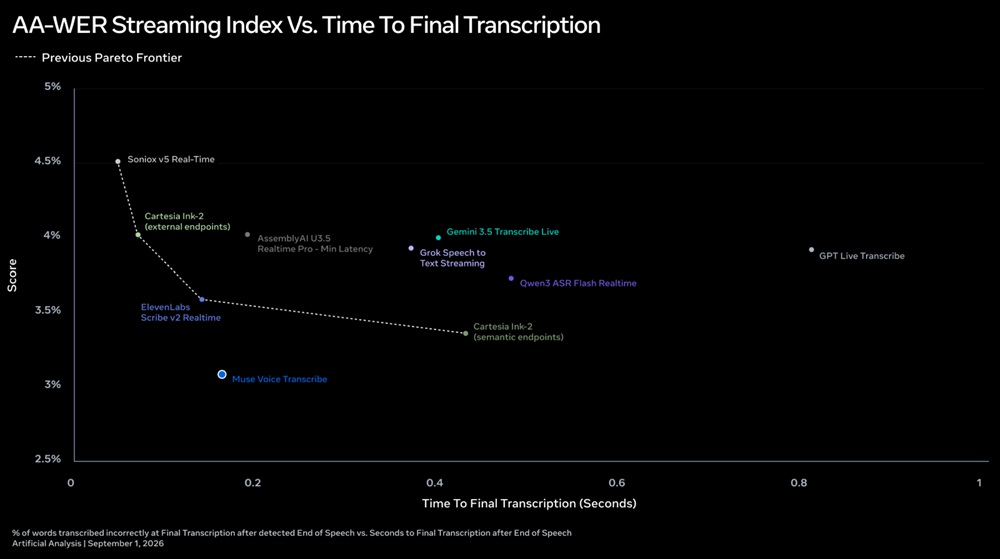
The model controls how much audio context it uses before transcribing each word, which Meta calls delay. There is a trade-off between accuracy and latency, with longer delays potentially improving transcription accuracy while increasing latency.
Muse Voice Transcribe uses adaptive delay, dynamically changing the delay for each word based on its difficulty. This is enabled through reinforcement learning (RL), which combines a word error rate (WER) reward and a delay reward multiplicatively.
Meta says the model achieves the Pareto front on the speed-accuracy trade-off, measured by time to final transcription.
Speaker diarization and endpointing
Muse Voice Transcribe adds speaker diarization and endpointing to its streaming ASR.
Speaker diarization
The model uses two special tokens:
<|start_of_turn|>— marks a potential speaker switch<|speaker_{A-Z}|>— identifies the speaker
The <|start_of_turn|> token is predicted when a speaker switch occurs, while the speaker tag is predicted at the end of the audio chunk. Audio from the same speaker can be divided into multiple segments while retaining the same speaker tag.
Endpointing
For endpointing, the model uses:
<|speech_onset|>— marks the beginning of speech<|speech_endpoint|>— marks when the speaker finishes speaking
Meta trains diarization and endpointing together with streaming ASR, adding separate rewards for both tasks on top of the ASR reward.
Language support and code-switching
Muse Voice Transcribe has been trained on 70+ languages, with 25 extensively verified. Meta recommends the 25 validated languages for the initial release, while additional languages are also supported.
The model supports arbitrary code-switching, including switching languages within a sentence or between sentences.
It also supports:
- Language biasing
- Keyword biasing
- Context biasing
Meta says context biasing can further improve recognition accuracy for code-switched speech.
Long audio and multi-speaker support
Muse Voice Transcribe supports:
- Audio inputs exceeding one hour
- 20+ speakers
- No required post-processing
Benchmark results
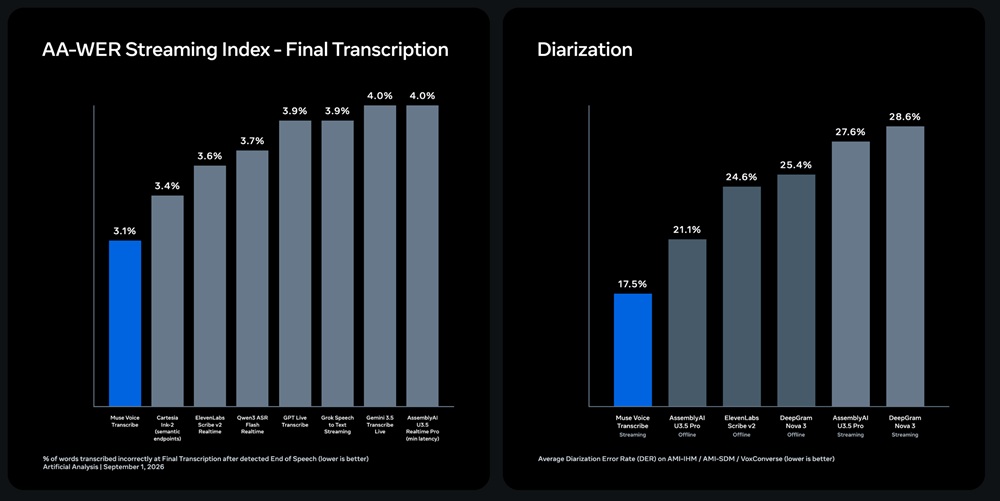
Meta says Muse Voice Transcribe ranks first on:
- Artificial Analysis for streaming speech-to-text
- Public diarization benchmarks
The company says the model inclusion and rankings are based on results as of September 1, 2026.
Applications and availability
Voice dictation across Meta AI and Muse Code is powered by Muse Voice Transcribe. It can be used with any application and any window on the screen, with users able to hold the Fn key to use it.
Muse Voice Transcribe is available today through:
- Meta Model API
- Meta AI for Mac
- Muse Code