Meta Superintelligence Labs has introduced Muse Glimmer, a 30-billion-parameter open-weight model designed for always-on local agent workflows. The model is released under the Apache 2.0 license and is designed to run on a Mac or PC with a single consumer GPU.
Muse Glimmer is aimed at local agents, function calling, coding, and LLM-as-a-judge evaluation. It is designed for AI workflows that can run locally without depending on cloud infrastructure or network access.
How Muse Glimmer was trained
Agents that manage schedules, draft messages, organize files, and adapt to how users work require access to personal context. Meta designed Muse Glimmer to combine long-horizon execution, precise tool calling, multimodal understanding, long-context memory, and instruction following.
The model was designed to balance these capabilities with the memory and compute constraints of local hardware. Meta used a compact architecture, a distillation approach that transfers agentic reasoning from a much larger teacher model, and inference optimizations including quantization.
The training process was divided into three stages:
- Pre-training: Muse Glimmer was trained on Muse Spark’s outputs using logit distillation, with a similar data mix as the teacher.
- Mid-training: The model was trained on longer-context and more agent-focused data with richer reasoning traces, along with organic data.
- Post-training: Meta combined supervised fine-tuning with on-policy distillation and reinforcement learning across general, reasoning, coding, and agentic domains.
Meta evaluated Muse Glimmer under the standards of its Advanced AI Scaling Framework and assessed it for open-weight release across the relevant categories.
Built for agentic workflows
Muse Glimmer is trained and evaluated across capabilities required for agentic tasks. These include:
- End-to-end task completion: The model is evaluated on DeepSearch QA, MCP-Atlas, τ-Bench, and SWE-Bench. These benchmarks measure its ability to work within scaffolds, write and debug code, and resolve multi-turn requests from start to finish.
- Tool use: It handles a range of function calls and invokes tools using precise schemas throughout extended workflows.
- Multi-step reasoning: The model chains reasoning over long horizons and sustains plans across complex, extended workflows.
- Failure recovery: When a tool call fails or produces an unexpected result, the model is trained to diagnose the error and retry rather than halt.
- Multimodal input and reasoning: A dedicated perception encoder allows the model to accept interleaved text and images and interpret screenshots, charts, and documents alongside conversations.
- Scaffold compatibility: Muse Glimmer works with OpenClaw and other agentic orchestration patterns.
- Controllable effort: The model supports different reasoning strengths to select a balance between quality and speed.
- Multilingual: Muse Glimmer is trained on data covering more than 100 languages.
Performance
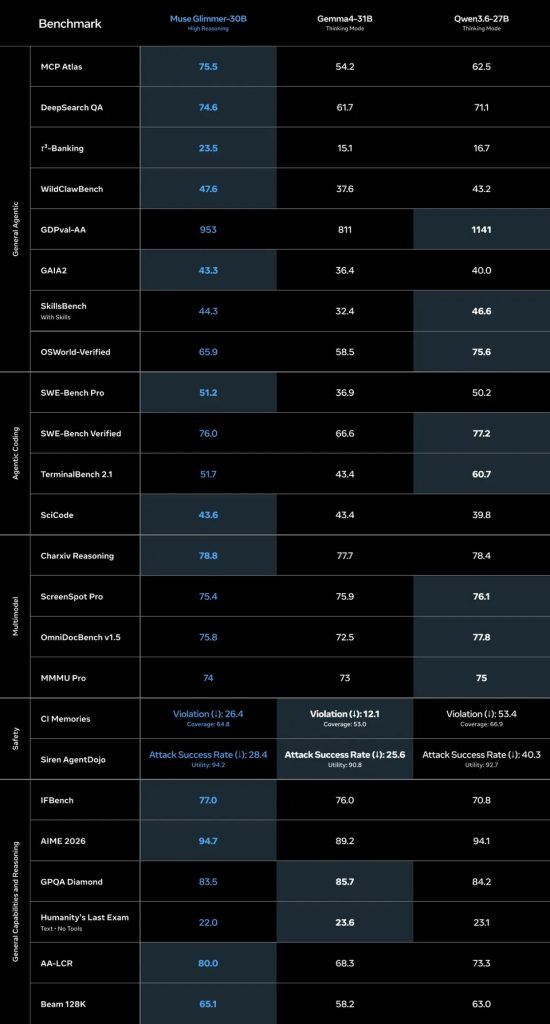
Meta evaluated Muse Glimmer across a broad range of benchmarks covering the capabilities required for autonomous agent behavior. The model was compared with Gemma4-31B and Qwen3.6-27B and, according to Meta, performs strongly for its size class on several widely used LLM benchmarks.
Optimized for local deployment
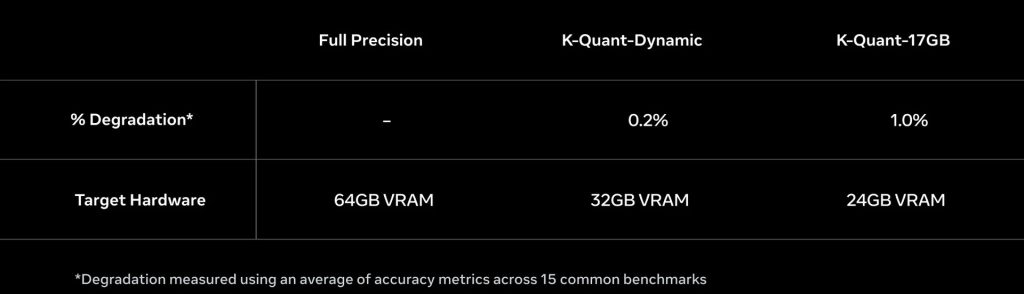
At full precision, a 30-billion-parameter model would require more than 55GB of memory. Meta uses quantization to compress the model weights to approximately 4-bit precision, reducing the language model to under 20GB.
This leaves enough memory for the model’s KV cache, the perception encoder for image understanding, and the speculative decoding drafter to run simultaneously within a 24GB or 32GB memory configuration. Meta says it validated the compression with minimal to no degradation on agentic tasks.
Faster generation through speculative decoding
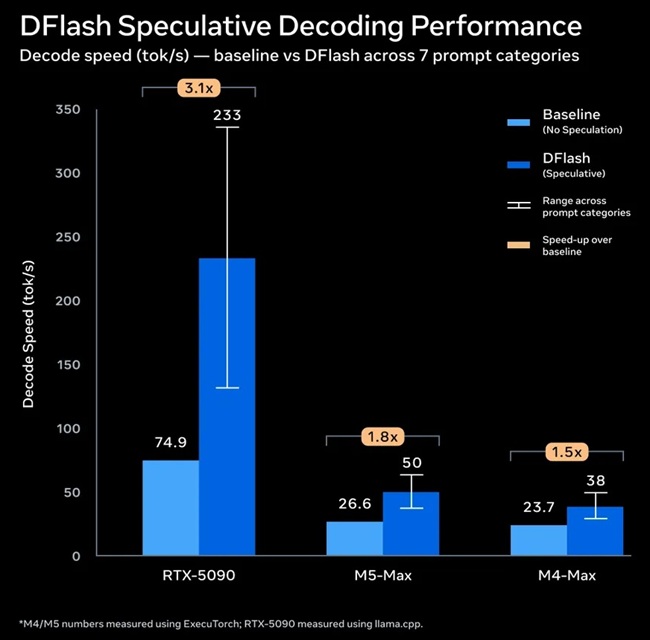
Muse Glimmer uses a lightweight drafter model based on DFlash. The small companion network proposes blocks of tokens at once, after which the main model verifies the proposals in parallel, accepting correct tokens and correcting incorrect ones.
Meta says this allows Muse Glimmer to generate text significantly faster than standard token-by-token generation while producing identical output quality. Quantized versions of the drafter are included to reduce additional memory overhead.
Meta measured the K-Quant-17GB model alongside the quantized DFlash drafter on the MacBook M4 Max, MacBook M5 Max, and NVIDIA RTX 5090. Meta says the model is fast enough for fluid conversation and real-time agent interaction while running entirely on the device.
Availability and deployment
Muse Glimmer is available now as open model weights through Hugging Face under the Apache 2.0 license. Meta has also released developer documentation and resources for building and running agents, including guidance for setting up custom scaffolds.
The model can be used across several local, edge, serving, and AI platforms:
- Local platforms: Ollama, LM Studio, and Unsloth
- Edge frameworks: llama.cpp, ExecuTorch, and MLX
- Serving frameworks: vLLM and SGLang
- AI platforms: Together AI, Fireworks AI, and OpenRouter
Integrations with llama.cpp, MLX, and ExecuTorch are expected in the coming days. Developers can also customize Muse Glimmer using PyTorch’s TorchTitan training feature.
Meta is working with AMD, Arm, Dell, Intel, and NVIDIA to optimize performance across devices. The company has also released resources through its AI Developer Center for developers working with the model.